Signs of a hidden water leak in your home
A slow leak inside a wall or under a floor can run for weeks before anyone notices. These are the clues worth acting on early.
Watch for damp or stained patches that grow, a musty smell, bubbling paint or lifting flooring, a water meter that turns when everything is off, a boiler that keeps losing pressure, warm spots on a floor, and a water bill that jumps for no reason. Any one of these is worth a closer look. Two or more together make a leak much more likely, especially if they sit near a pipe run.
Water leak signs you can see and smell
- A stain that grows. Mark the edge of a ceiling or wall stain in pencil. If it has spread in a day or two, water is still arriving.
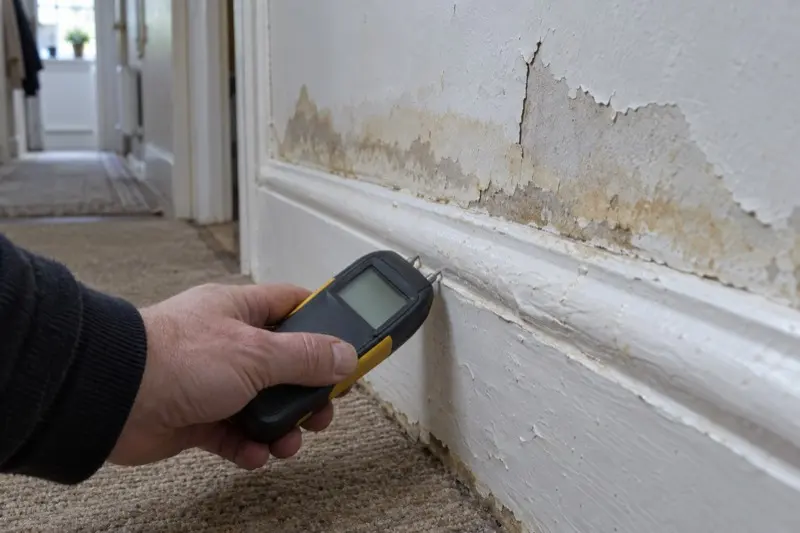
- Bubbling or flaking paint, peeling wallpaper. Water pushing through plaster lifts the finish from behind.
- A musty, earthy smell in one room or cupboard, often before anything is visible.
- Black mould appearing in a spot that is not a steamy bathroom or a cold corner.
- Lifting laminate, loose tiles or cracked grout on a floor that used to be flat.
- Damp skirting boards or skirting that has started to swell and split.
Leak signs from the water and heating systems
- The water meter keeps moving when every tap, appliance and toilet is off. The meter test takes half an hour.
- The water bill jumps with no change in how many people live there or how you use water.
- The boiler keeps losing pressure and you are topping it up every few days. See boiler losing pressure.
- A warm patch on a solid floor that spreads wider than a pipe run, or stays warm when the heating and hot water are off, can mean a heating or hot water pipe is leaking into the screed.
- The sound of running water when nothing is running, usually clearest at night.
- Low water pressure at the taps that came on gradually.
Signs of an underground leak outside
A patch of lawn or driveway that stays wet in dry weather, grass that is greener in a line across the garden, or a sunken area over where the supply pipe runs can all mean an underground leak. Water escaping on the supply pipe between your boundary and the house is usually the homeowner's responsibility, so it pays to find it quickly.
What to do if you suspect a hidden leak
If you can see water actively coming in, turn off the stopcock first and follow what to do when you find a leak.
If the signs are slow and the source is hidden, the next job is finding it. Guessing is expensive: opening up the wrong wall or floor adds cost to the claim and to your home. ADI's engineers use thermal imaging, acoustic listening, tracer gas and moisture mapping to pinpoint the leak first, then put what they found in a report your insurer and loss adjuster can use.
If you have buildings insurance, check whether it includes trace and access cover. Many policies do, usually up to a set limit such as £5,000, and it can pay for finding the leak and opening up to reach it. Most policies only pay where the leak has caused damage that the escape of water section covers.
Common questions
Can a hidden leak cause damage without any visible water?
Yes. A slow leak inside a wall, under a floor screed or in a ceiling void can soak insulation, timber and plaster for weeks before a stain appears. By then the drying and repair bill is usually much bigger than the leak itself.
Is damp always a leak?
No. Condensation, penetrating damp from outside and rising damp can look similar. A leak tends to be localised, often near a pipe run, and it does not follow the weather. Moisture readings taken in a pattern across the area help tell them apart.
More leak guides
-
What to do when you find a leak
The first hour: stopping the water, keeping safe, the photos your insurer will want, and who to ring in which order.
-
High water bill? Check for a leak
How to test your meter in half an hour, who is responsible for which pipe, and why a leak on your supply pipe can cost you twice.
-
Water coming through the ceiling
Where the water is most likely coming from, when a stained ceiling becomes dangerous, and what insurance tends to cover.
-
Boiler losing pressure
If you are topping the boiler up every few days, the water is going somewhere. How to tell a boiler fault from a hidden heating leak.