Leak under a concrete floor
Many UK homes have water and heating pipes buried in a concrete floor or screed. When one of them leaks, the water has nowhere to go but sideways and up.
Common signs are a warm patch on the floor, damp or swollen skirting boards, tiles lifting or grout cracking, flooring that feels soft, a meter that turns with everything off, or a boiler that keeps losing pressure. The leak can usually be pinpointed from the surface with thermal imaging, acoustic listening and tracer gas, so only a small section of floor needs breaking out.
Signs of a leak under the floor
- A patch of floor that feels warmer than the rest and spreads wider than a pipe run, or stays warm when the heating and hot water are off.
- Damp that appears at the base of walls and skirting boards and spreads along them.
- Laminate or wood flooring that swells, cups or lifts; tiles that loosen; grout that cracks or darkens.
- A musty smell with no obvious source.
- The water meter moving with everything off, or the heating pressure dropping.
Why not just break up the floor?
Because the water shows up where it can escape, which can be metres from where the pipe has failed. Breaking out a floor on a guess can mean lifting a whole kitchen, taking out units, then finding the leak was under the hall. Every extra square metre adds to the repair, the drying time and the claim.
How the leak is found
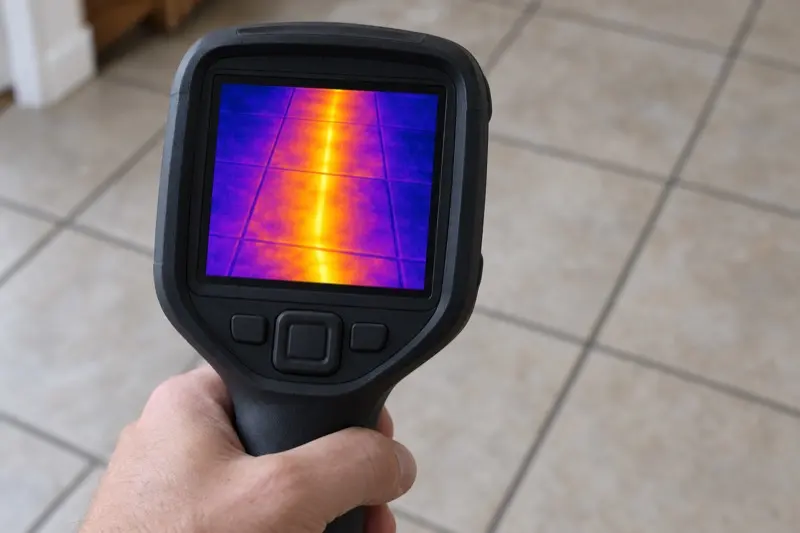
- Thermal imaging shows the heat pattern of hot water or heating pipes and the warm bloom where water is escaping.
- Acoustic listening picks up the sound of water escaping under pressure through concrete.
- Tracer gas is a safe mix pushed into the drained pipe; it rises through the floor at the leak and is picked up by a sensitive detector.
- Pressure testing confirms which pipe run is losing water, so the search is narrowed before anything is opened.
The result is a marked spot on the floor and a written report with photos and readings.
Insurance and trace and access
Under-floor leaks are exactly what trace and access cover is for: the cost of finding the leak and opening up the floor to reach it. The damage the water caused is usually a separate part of the escape of water claim. On a bigger job, expect the insurer to appoint a loss adjuster.
More leak guides
-
Signs of a hidden leak
Damp patches, a meter that never stops, a boiler that keeps losing pressure, and the other clues that water is escaping somewhere you cannot see.
-
What to do when you find a leak
The first hour: stopping the water, keeping safe, the photos your insurer will want, and who to ring in which order.
-
High water bill? Check for a leak
How to test your meter in half an hour, who is responsible for which pipe, and why a leak on your supply pipe can cost you twice.
-
Water coming through the ceiling
Where the water is most likely coming from, when a stained ceiling becomes dangerous, and what insurance tends to cover.